
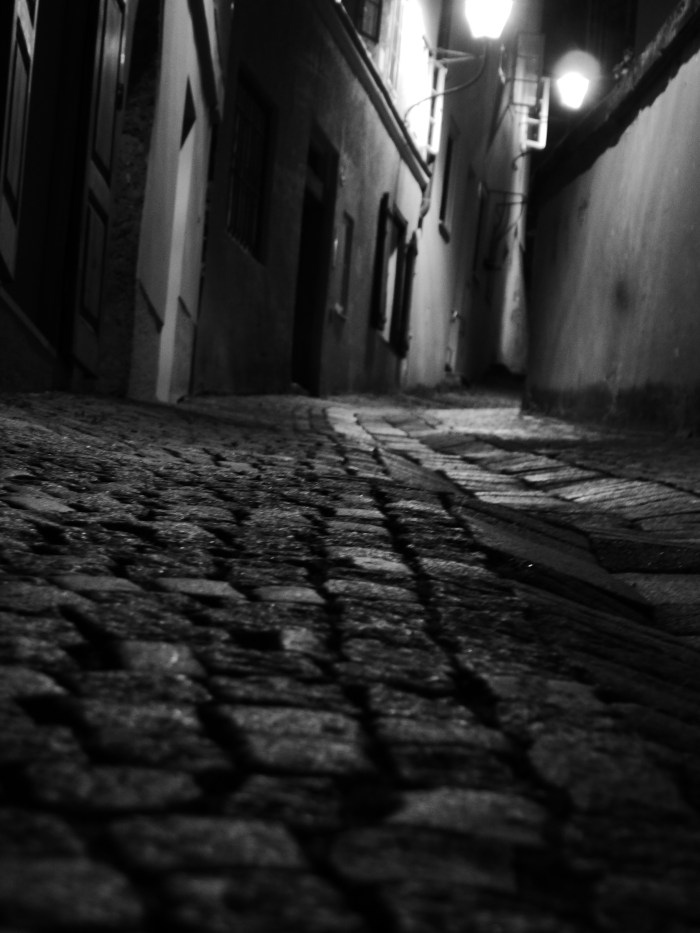
旧東海道沿い 品川, 東京 Shinagawa, Tokyo
Tokyo, 2021 #04 — Flaneur
A collection of writings about place space writing and art …
旧東海道沿い 品川, 東京 Shinagawa, Tokyo
Tokyo, 2021 #04 — Flaneur
by Marcus D. Niski
Writer, mystic, sage, scholar, junky and literary outlaw William S. Burroughs was undoubtedly one of the most controversial writers of the twentieth century.
Often dismissed by early literary critics as outlandish and unreadable, a deeper examination of the Burroughs’ cannon reveals a complex many-sided personality whose far-ranging ideas provide many resonances for the twenty-first century and beyond. From the perils of the nuclear age, to the nature of language, agencies of power and control and the ecological future of the planet, William S. Burroughs had many prescient things to say about the future of humanity and nexus between human beings, time and space, power and control.
Yet all too often overlooked are his extraordinary powers of observation as a primary writing tool: a theme that is so impressively developed and re-enforced in many of his lectures and writing workshops. Burroughs proffered that the trade skills of a writer are very much akin to the trade skills of the detective or the spy which accord with his view that one must vigorously apply oneself to the process of observation in honing and developing the craft skills of the writer.
To this end, Burroughs also spoke about a wide range of techniques that can be employed in order to develop and heighten a writer’s powers of observation, mental dexterity, and spontaneity. Burroughs points to the notion that all great writing – and by implication – all great art is about making the reader or the viewer more fully and more reflectively aware of their own circumstances and that of the world around them. Indeed, it was this notion that he further developed in his highly entertaining and engaging lectures and workshops on the art and craft of writing.
In 1982, at Naropa University – founded by legendary Beat writer Alan Ginsberg – William S. Burroughs gave arguably one of his finest lectures on the art and craft of writing in a workshop dedicated to the work of Jack Kerouac. Here he talked admiringly of his friendship with fellow writer Kerouac and explored Kerouac’s art and influence as a writer. Here also, we get a sense of Burroughs’ own unique insights into the craft of writing and a glimpse into some of the important influences that Kerouac had on his own work; as well as the extraordinary impact that the Beat generation have had on the history of twentieth century literature.
In Burroughs’ characteristically quirky yet insightful approach to his subject matter the question of “who is a writer,” what writers are doing in their work – and what it means to be a writer – Burroughs makes some important remarks about Kerouac, both as a person and as a writer, and addresses a number of questions surrounding Kerouac’s life and work. Here, Burroughs also specifically posits the key question surrounding the intent of the writer in his suggestion that:
“What is a writer actually doing?” replying that … “the general proposition that any artist – and I include all creative thinkers – … [is] trying to make the viewer, the reader, the student aware of what he knows and doesn’t know that he knows…”
Accordingly, Burroughs proposes that we seem to know ‘far more than we assume that we know’ yet this knowledge must be ‘unlocked’ by some form of intellectual provocation which stimulates our awareness and in turn leads us to making the necessary connections between the external stimulus and our internal awareness.
At a personal level, having listened extensively to Burroughs’ Naropa workshops – as well as having transcribed some of them – having visited the Butler Library Rare Book and Manuscript Library, Columbia University, New York to view some of Burroughs’ notebooks and literary artifacts, as well as having viewed some of his original manuscripts as held at the Berg Collection within The New York Public Library, I continue to remain captivated by both the depth and breadth of Burroughs’ attempts to move the craft of writing forward though both experimentation, exploration and extraordinary force of will.
Whether it be in his collaborative experimentation with Brion Gysin in developing the cut-up techniques, his continual probing of the magical, psychic and synchronistic relationships between the reader and/or receiver of the written text, or his inquiries into the collaborative process in Burroughs’ notion of The Third Mind, his contribution to the craft of writing and its potentialities remain an important achievement in terms of the influence he has had on an extraordinarily broad range of creators whether it be writers, artists, musicians or philosophers who seek to continue the quest for the limits of human creativity and the conquest of new grounds of psychic terrain.
Burroughs’ legacy undoubtedly remains firmly grounded in the outpouring of creative energy and accomplishments of those who have followed after him. Having declared that in his view that – “the only goal worth striving for is immortality” – Burroughs’ place in the pantheon of twentieth century writers would seem to be unquestionably assured.
In an age that more than ever requires us to go beyond the superficial, to question the operation of modes of power and control and to forge ahead with seeking out new modes of creativity in the face of seemingly unending banality, Burroughs’ ideas continue challenge us just as much now as they have always done throughout his turbulent yet extraordinarily creative life.
As Peter Schjeldahl wrote in his New Yorker piece on Burroughs entitled The Outlaw: The extraordinary life of William S. Burroughs (2014), Schjeldahl suggests that, “His [Burroughs’] palpable influence on J. G. Ballard, William Gibson, and Kathy Acker is only the most obvious effect of the kind of inspiration that makes a young writer drop a book and grab a pen…”
Thankfully, we can look forward to future generations of writers who continue to take up the cudgels of Burroughs’ continual questioning of the human condition and his quest to move it forward into ever deeper inventiveness in terms of literary creativity.
Perhaps as Schjeldahl notes in the final lines of his analysis in his piece on Burroughs, “When you have read Burroughs, at whatever length suffices for you, one flank of your imagination of human possibility will be covered for good and all”; an injunction that serves to invoke the continuing value of delving into Burroughs’ cannon despite its sometimes difficult, enigmatic and yet eternally rewarding complexity.
Marcus D. Niski © 2015-2021
‘But as his friend Jaime Sabartes recalled, his trusty pocket notebook remained his companion:
“Picasso was endeavoring to recapture the simplicity of our life as young men, despite the manifold and profound changes in us and around us. He wanted to return to a bygone period in our lives. He neither painted nor sketched and never went up to his studio except when it was absolutely necessary, and even then he put it off from day to day, no matter how urgent. In order to occupy his imagination, he wrote-with a pen if he found one handy, or a small stub of pencil-in a little notebook which he carried about with him in his pocket. He wrote everywhere.” ’
As quoted in ‘The Pocket Notebooks of 20 Famous Men’ in The Art of Manliness as found at: https://www.artofmanliness.com/articles/the-pocket-notebooks-of-20-famous-men/
And the nights, bigger than imagining: black and gusty and enormous, disordered and wild with stars.
— Donna Tartt, The Secret History. (Vintage (April 13, 2004) Originally published 1992.
Donna Tartt — The Vale of Soul-Making

Le soleil s’essaime en diamants
de gouttes d’eau
sur l’herbe souple
Je reste docile
à l’inclination de l’univers serein
Les montagnes se dilatent
en gorgées d’ombre lilas
et vaguent avec le ciel
Là-haut à la voûte légère
l’enchantement s’est brisé
Et je tombe en moi
Et je m’enténèbre dans mon coin
Versa, 27 avril 1916
*** Giuseppe Ungaretti (1888-1970) – Sentimento del tempo (1933) – Vie d’un homme. Poésie, 1914-1970 (Poésie/Gallimard, 1981) – Traduit de l’italien par Jean Lescure.
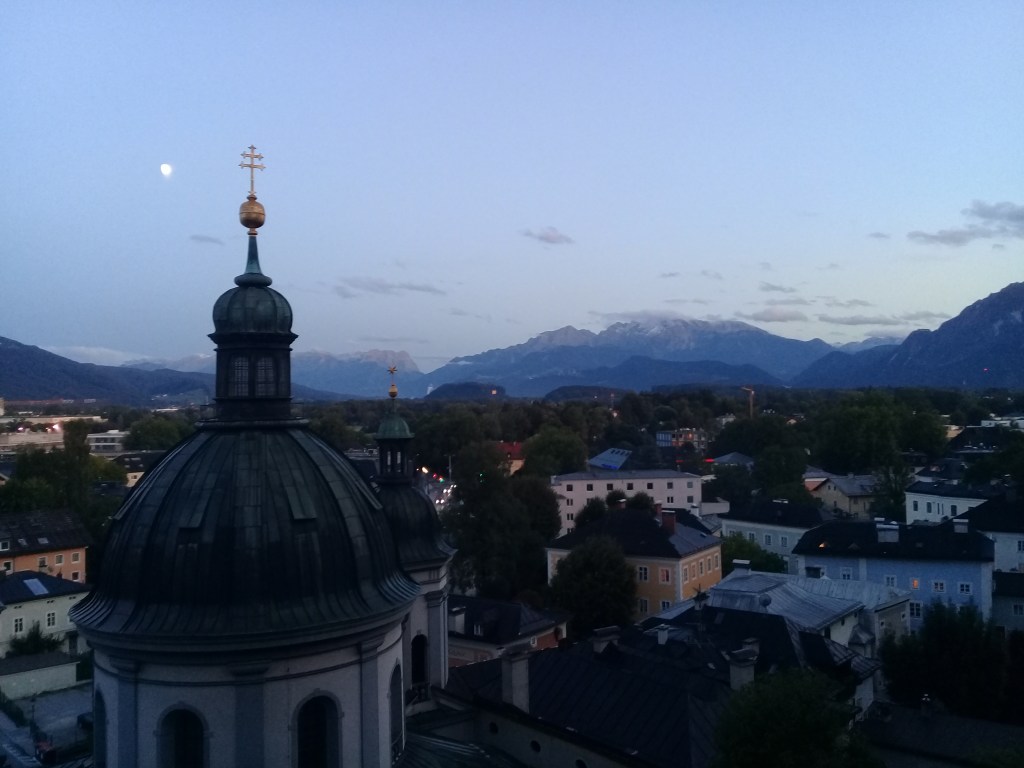
Salzburg Altstadt – St Erhard, Nonntal
Photography by Marcus D. Niski © 2019
“There’s never really any originality. We live in a sort of large-scale exchange, a sort of grand intertext. Ideas circulate and languages too. In the end, the only thing we can do—and claim it as our own—is to combine them. That’s more or less how I see things. But you don’t create an idea—it’s there, it’s like a sort of major transaction in a large-scale economy. Ideas circulate and, at a certain point, you stop them, arrange them and edit them, a little bit the way they do in films, and that produces a work.”
Roland Barthes, ‘Simply a Particular Contemporary’, (trans. Chris Turner)

The Brooklyn Bridge literally loomed large in my Brooklyn family’s history for a century, so I was intrigued when I stumbled upon this impressive limited edition volume. The accordion-fold book Brooklyn Bridge with a poem by the 20th century Russian poet Vladimir Mayakovsky and original woodcuts by Canadian printer and book designer Glenn Goluska . The award-winning […]
Here Stood Mayakovsky — Travel Between The Pages


 Naked Cities Journal
You must be logged in to post a comment.