Sometimes intriguing. Sometimes ornate. Sometimes narrow. Sometimes wide. Sometimes majestic. Sometimes mundane. Always functional.
This image was taken by me at the legendary Chelsea Hotel in New York, 2010.
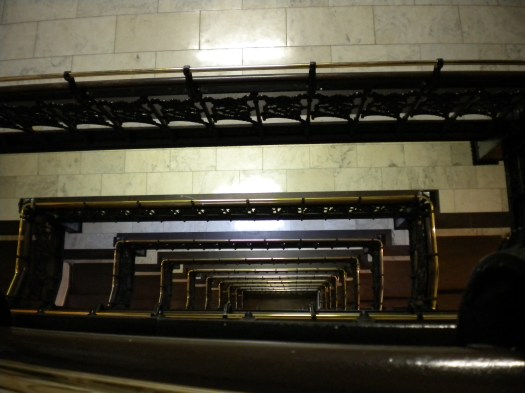
Image © Marcus D. Niski 2010-2017
A collection of writings about place space writing and art …
Sometimes intriguing. Sometimes ornate. Sometimes narrow. Sometimes wide. Sometimes majestic. Sometimes mundane. Always functional.
This image was taken by me at the legendary Chelsea Hotel in New York, 2010.
Image © Marcus D. Niski 2010-2017

Light of the Train – Kyoto, Japan I thought this would make an appropriate image to wrap up my long series on Kyoto. All told, I have 35 posts about Kyoto, the photos of which I shot all on the same day. This does not include the photos from Kyoto Station, which I took on […]

The Art Nouveau doors to the left offer entry, according to a caption, to a building called the Maison aux Grenouilles (frogs) in Brelsko-Biala, Poland. The doors are near the beginning of a collection of photographs labeled “Bejaroti ajtok: a village mind,” which arrived in my email inbox from my dear mother-in-law, Agnes, who received […]

André Kertész (2 July 1894 – 28 September 1985). Another Austro Hungarian Giant of the 20th Century, Andre Kertesz started life in a Budapest before moving to the countryside having lost his father to TB. It was to be a seminal moment. Like a lot of the previous Greats we’ve covered he started off […]
via Street Photography Greats. Andre Kertesz — The Street Photographer’s Guide

“Art is restoration: the idea is to repair the damages that are inflicted in life, to make something that is fragmented – which is what fear and anxiety do to a person – into something whole.”
– Louise Bourgeois. French, American, sculptor, installation artist
“Louis Aragon guides us through the Passage de L’Opéra, imaginatively exploring the allure of various establishments found in the covered arcades, including seedy lodging houses, cafés, hairdressing salons, public baths, theatres, washrooms and quaint specialist shops selling such items as handkerchiefs, walking sticks, and exotic stamps. He evokes the ambiguity of these places, their pleasures and secrets: ‘the ephemeral, the ghostly landscape of damnable pleasures and professions’. Aragon playfully opens up the arcades as diverse laboratories of sensations against what he sees as respectable, inoffensive bourgeoisie sensibilities. The passageway becomes a ‘method’ for loosening inhibitions, revealing both the shadowy and bright secrets that can be found behind its doors. In his stroll through Passage de L’Opéra the public baths and brothel are described in terms of ‘other places’, different worlds secreted in the heart of Paris, and when he moves out to the district of Butts-Chaumont, Aragon’s description and celebration of gardens and parks likewise become zones of mystery and enchantment. Gardens become places of, and for, dreams and mad invention. Parks, particularly at night, become places of sensual delight and lurking danger.”
Review of Peter Aragon’s Paris Peasant by Peter Johnson (12 February 2014) via http://www.heterotopiastudies.com/paris-peasant-aragon/


Page Images from A Rare Hardcover Edition of Paris Peasant. Photography by Marcus D. Niski © 2004-2017

This fabulous spontaneous street photography piece – Smiling At Strangers – was put together by Ieva Kambarovaite and posted on her blog at mokitadreams.com –
“Sat in a coffee shop, watching the world and taking pictures of strangers. Who knew? They smiled. Big and genuine smiles. Brits are not so miserable after all (got to work on my sarcasm). I hope you have a great day and I hope you smile at strangers. Surprise Harmony…”

Designed and created by Josephine R. Unglaub.

Meet J.S. Graboyes, an illustrator of streets and urban scenes …
via Illustrating Streets of the World: The Art of Jeremy Graboyes — Discover
Destiny never consists in step-by-step deterministic relations between presents which succeed one another according to the order of a represented time. Rather, it implies between successive presents non-localisable connections, actions at a distance, systems of replay, resonance and echoes, objective chances, signs, signals, and roles which transcend spatial locations and temporal successions. — Gilles Deleuze, […]
 Naked Cities Journal
You must be logged in to post a comment.