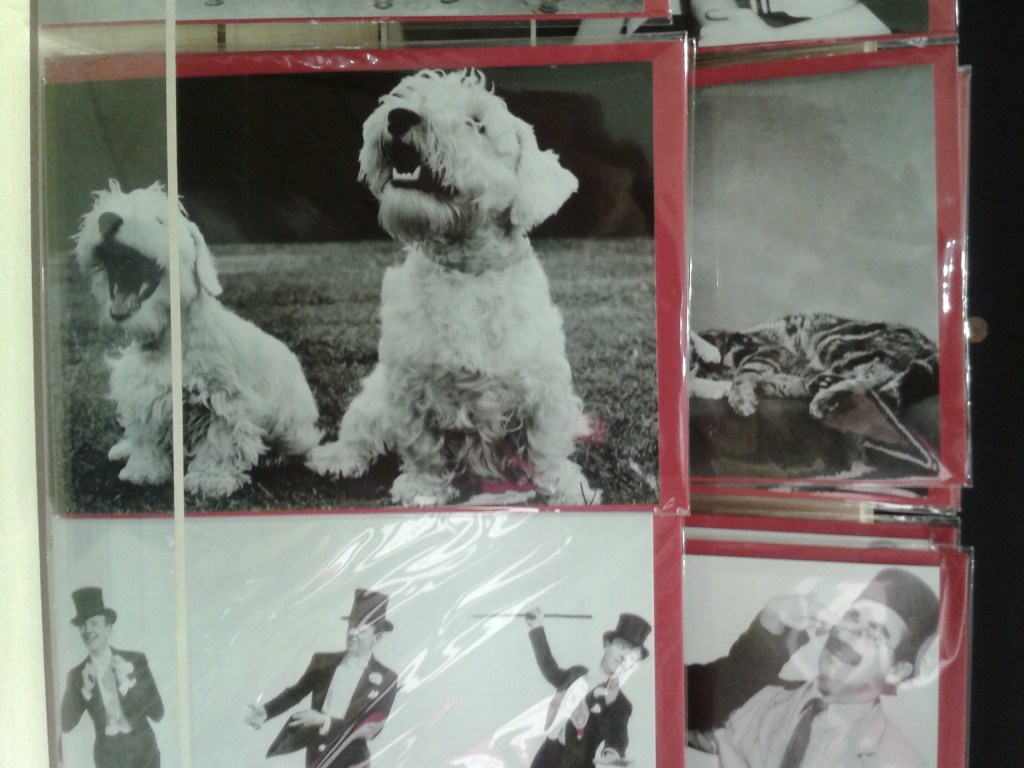
Sealyhams – Window Display
Image © Marcus D. Niski 2013
A collection of writings about place space writing and art …
Sealyhams – Window Display
Image © Marcus D. Niski 2013

As writers, we often find ourselves collecting notebooks in an attempt to fill them. Just as often, the ratio of empty notebooks to full starts to lean heavy on the “empty” side, but our compulsion to surround ourselves with empty pages is real. Curious that, for many of us, the empty page is a source […]
Six notebooks that guarantee you will get some writing done today, probably — B.W. McDermott

Some observations popping out when I was reading two books during the lockdown: Anatomie Artistique de l’Homme (1959) by Arnoult Moreaux and the Artist’s Handbook (1987) by Ray Smith. Two books which deeply modified the way I was seeing things around me, landscapes as well as people, bodies. And also, it gave another insight into […]
Art practice — Space in light

Looking up at New York’s buildings isn’t the only way to get a sense of the city’s past. Cast your eyes down on the sidewalk and street, and you’ll start seeing an incredible variety of manhole covers—many from the 19th and early 20th centuries. These iron lids serve a utilitarian purpose. But the men who […]
via Manhole covers that left their mark on the city — Ephemeral New York

In March 1970, a traveler now living in Rotterdam paid a visit to New York City. Jaap Breedveld was in his 40s at the time. Like many tourists, he took photos that reflect the typical itinerary of a sightseer from overseas, like Times Square (above, with the old Howard Johnson’s at 46th Street on the […]
via What a tourist saw on a trip to New York in 1970 — Ephemeral New York
New York was an inexhaustible space, a labyrinth of endless steps, and no mater how far he walked, no matter how well he came to know its neighborhood and streets, it always left him with the feeling of being lost. Lost, not only in the city, but within himself as well. Each time he took a walk, he felt as though he were leaving himself behind, and giving himself up to the movement of the streets, by reducing himself to a seeing eye, he was able to escape the obligation to think, and this, more than anything else, brought him to a measure of peace, a salutary emptiness within… Motion was of the essence, the act of putting one foot in front of the other and allowing himself to follow the drift of his own body. By wandering aimlessly, all places became equal, and it no longer mattered where he was. On his best walks, he was able to feel that he was nowhere. And this, finally, was all he ever asked of things: to be nowhere. New York was the nowhere he had built around himself, and he realized that he had no intention of ever leaving it again.
Paul Auster in City of Glass as quoted in Paul Auster’s New York, Henry Hold and Company, New York)
The feeling that emerges from these glimpses of city life is roughly equivalent to what one feels when looking at a photograph. Cartier-Bresson’s “decisive moment” is perhaps the crucial idea to remember in this context. The important thing is readiness: you cannot walk out into the street with the expectation of writing a poem or taking a picture, and yet you must be prepared to do so whenever the opportunity presents itself. Because the “work” can come into being only when it has been given to you by the world, you must be constantly looking at the world.
From: The Art of Hunger, as quoted in Paul Auster’s New York, Henry Hold and Company, New York)

“Memory is each man’s poet-in-residence.” – Stanley Kunitz, poet
via “Memory is each man’s poet-in-residence.” — Art of Quotation
Decay
Ruins
Detritus
The Mundane
The Moment
Ennui
Boredom
The Obvious
The Un-Noticed
The Notebook
[MN] 24 August 2018
The memorable is that which can be dreamed about a place.
– Michel de Certeau, ‘Walking in The City’ in The Practice of Everyday Life
 Naked Cities Journal
You must be logged in to post a comment.