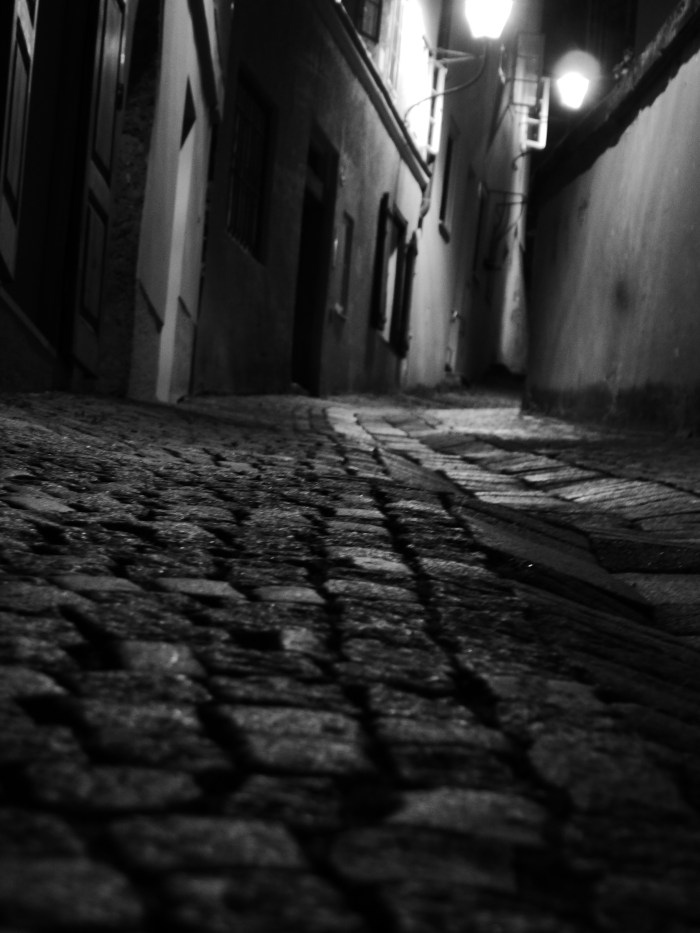
Think of how the desert gets turned into metaphor in postmodern rhetoric where it functions as the place of origins, endings and hard truths: the place at the end of the world where all meanings and values blow away; the place without landmarks that can never be mapped; the place where nothing grows and nobody…
Michel de Certeau — The Vale of Soul-Making
To walk is to lack a place. It is the indefinite process of being absent and in search of a proper. The moving about that the city mutliplies and concentrates makes the city itself an immense social experience of lacking a place – an experience that is, to be sure, broken up into countless tiny […]
Graffiti — cakeordeathsite

Brassaï’s close-ups of graffiti carved and painted on Parisian city walls were first seen in the Surrealist magazine Minotaure in 1933, however he would continue to photograph images of graffiti for the next three decades, culminating in the publication of the book, Graffiti, in 1961. With this project, ‘the eye of Paris’ as he was called […]
Glow — For Earth Below

Macabre — Liminal Narratives
Ghost signs, as we have seen, haunt the margins of many zones. Here, fixed categories blur before our eyes. These faded imprints, inked or carved on shop face or wall, elide past, present, future, materiality, insubstantiality, presence and absence. To those that care to listen, they murmur of long-forgotten brands — cigarettes, flour, razors — […]
Homage to “Manhatta” — For Earth Below

What a tourist saw on a trip to New York in 1970 — Ephemeral New York

In March 1970, a traveler now living in Rotterdam paid a visit to New York City. Jaap Breedveld was in his 40s at the time. Like many tourists, he took photos that reflect the typical itinerary of a sightseer from overseas, like Times Square (above, with the old Howard Johnson’s at 46th Street on the […]
via What a tourist saw on a trip to New York in 1970 — Ephemeral New York
Paul Auster’s New York
New York was an inexhaustible space, a labyrinth of endless steps, and no mater how far he walked, no matter how well he came to know its neighborhood and streets, it always left him with the feeling of being lost. Lost, not only in the city, but within himself as well. Each time he took a walk, he felt as though he were leaving himself behind, and giving himself up to the movement of the streets, by reducing himself to a seeing eye, he was able to escape the obligation to think, and this, more than anything else, brought him to a measure of peace, a salutary emptiness within… Motion was of the essence, the act of putting one foot in front of the other and allowing himself to follow the drift of his own body. By wandering aimlessly, all places became equal, and it no longer mattered where he was. On his best walks, he was able to feel that he was nowhere. And this, finally, was all he ever asked of things: to be nowhere. New York was the nowhere he had built around himself, and he realized that he had no intention of ever leaving it again.
Paul Auster in City of Glass as quoted in Paul Auster’s New York, Henry Hold and Company, New York)
Paul Auster’s New York
The feeling that emerges from these glimpses of city life is roughly equivalent to what one feels when looking at a photograph. Cartier-Bresson’s “decisive moment” is perhaps the crucial idea to remember in this context. The important thing is readiness: you cannot walk out into the street with the expectation of writing a poem or taking a picture, and yet you must be prepared to do so whenever the opportunity presents itself. Because the “work” can come into being only when it has been given to you by the world, you must be constantly looking at the world.
From: The Art of Hunger, as quoted in Paul Auster’s New York, Henry Hold and Company, New York)
Salzburg Altstadt – Panorama
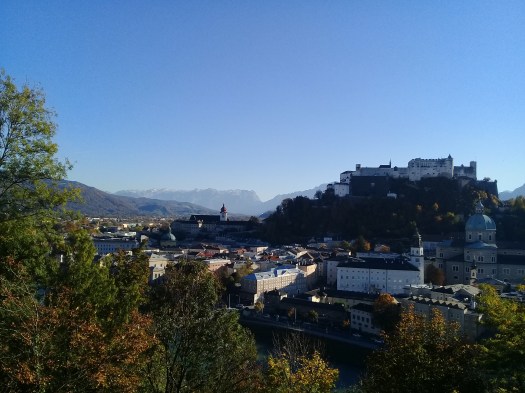
Salzburg Altstadt Panorama
Photography by Marcus D. Niski © 2019
 Naked Cities Journal
You must be logged in to post a comment.