” …

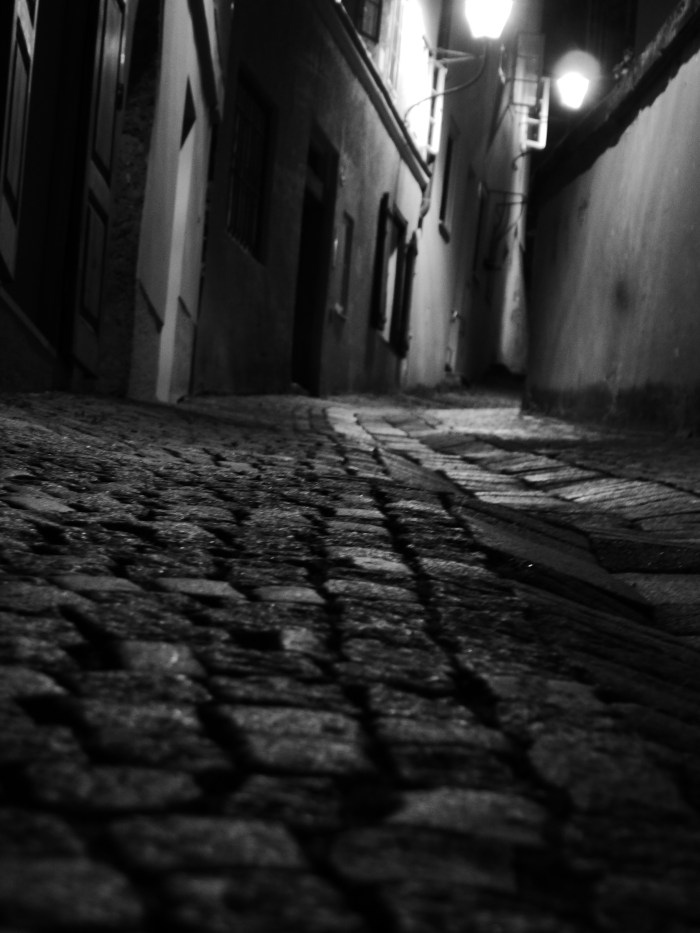
The Arcades book [Das Passagen-Werk] was never intended to be an economic history (though part of its ambition was to act as a corrective to the entire discipline of economic history). An early sketch suggests something far more like his autobiographical work, A Berlin Childhood [:] “One knew of places in ancient Greece where the way led down into the underworld. Our waking existence likewise is a land which, at certain hidden points, leads down into the underworld – a land full of inconspicuous places from which dreams arise. All day long, suspecting nothing, we pass them by, but no sooner has sleep come than we are groping our way back to lose ourselves in the dark corridors. By day, the labyrinth of urban dwelling resembles consciousness; the arcades… issue unremarked on to the streets. At night, however, under the tenebrous mass of the houses, their denser darkness protrudes like a threat, and the nocturnal pedestrian hurries past – unless, that is, we have emboldened him to turn into a narrow lane.”

Two books served Benjamin as models: Louis Aragon’s A Paris Peasant, with its affectionate tribute to the Passage de L’Opéra, and Franz Hessel’s Strolling in Berlin, which focuses on the Kaisergalerie and its power to summon up the feel of a bygone era. In his book, Benjamin would try to capture the “phantasmagoric” experience of the Parisian wandering among displays of goods, an experience still recoverable in his own day, when “arcades dot the metropolitan landscape like caves containing the fossil remains of a vanished monster: the consumer of the pre-imperial era of capitalism, the last dinosaur of Europe”.

… “

An extract from JM Coetzee’s highly engaging essay on Walter Benjamin: ‘The man who went shopping for truth’ as found at:

https://www.theguardian.com/books/2001/jan/20/history.society as accessed 30 September 2017-09-30


Impossible City: New Orleans – Places Journal

Sometimes you see a picture and you can tell that something’s missing, but you don’t know what it is …

Or you could try to fill the emptiness with something you love, as I love Walker Percy’s renderings in The Moviegoer:

The street looks tremendous. People on the far side seem tiny and archaic, dwarfed by the great sky and the windy clouds like pedestrians in old prints.

Via: Impossible City: New Orleans — Places Journal

Places

By Marcus D. Niski

From cradle to the grave we engage with places of differing kinds for differing reasons for better or for worse: places of horror and wonderment, places of joy and sorrow, places to rest, places to work, places that lift us up and places that bring us down, places of lightness and darkness: so many places inhabit our world…

                                                                                          Public Squares

Hospitals

Quadrangles

Churches


Prisons

Rooms

Universities

            Cemeteries

Hotels

Asylums

Fields

Hills

Valleys

         Dales

              Laneways

Fjords

            Escarpments


[MN] September, 2017

On ‘Seeing and Noticing’: William S. Burroughs, The Beat Hotel and ‘Taking The Colour Walk’ Through The Streets of Paris

By Marcus D. Niski

In a dilapidated hotel famously dubbed The Beat Hotel by its colourfully eccentric inhabitants, a coalescence of some of the Beat generation’s most important protagonists came together under one roof to push forward the frontiers of literature, painting and psychic awareness.

In an extraordinary outburst of creative energy, Gregory Corso wrote some of his most important poetry there, Brion Gysin and Ian Sommerville devised The Dreamachine , Allen Ginsberg worked on Kaddish (dwelling in Room 25), Burroughs and Gysin experimented with the ‘cut-ups’ and Sinclair Beiles – amongst many others who came and went –  co-authored Minutes to Go with Burroughs and Gysin amidst a burlesque carnival of creative chaos.

Always seeking new paths of creative inspiration, Burroughs also devised a fascinating observational technique known as ‘taking the colour walk’:

“I was taking a colour walk around Paris the other day … I was walking down the boulevard when I suddenly felt this cool wind on a warm day, and when I looked out I was seeing all the blues in the street in front of me… blue on a foulard…a girls’ blue sweater…blue neon…the blue sky …all the blues. When I looked again, I saw nothing but all the reds…of traffic lights…car lights…a café sign…a man’s nose…”

Excerpt from The Beat Hotel, Barry Miles, Atlantic Books, London, 2000, p 157.

Located at 9, rue Git-le-Coeur and curated under Madame Rachou’s ever watchful eye (circa 1957-1963), The Beat Hotel was undoubtedly one of the great oasis’ of Parisian creativity at that time. Indeed, in this extraordinary interview below, Sinclair Beiles recalls some of the legendary ‘eccentricities’, excesses and antics that took place amidst the dilapidated digs of  The Beat Hotel –

More biographical information about Sinclair Beiles – one of the Beat generation’s most neglected, if not tragically overlooked protagonists – can also be found at:

http://www.emptymirrorbooks.com/beat/sinclair-beiles-a-man-apart/


 – Marcus D. Niski, September 2017


Writing About Place and Space

By Marcus D. Niski

One of the things that I have long been captivated by are the elements of place and space. How we ‘see’ the world around us, and how we ‘react’ to it. The pictures we create in our minds that surround our daily lives and how we interpret them. How we react to ‘mundane things’, ‘objects’ and ‘occurrences’ that shape our reality.

My thesis has long been that the increasing pace of our society puts us less in touch with the simple mundane things that are so present in our everyday reality (or should be!). Our media, entertainment, and lives in general have been ‘dumbed down’ to accommodate such rapid exponential change.

Some of the greatest writers – in my opinion – are those who are able to ‘slow us down’ to really focus in on what most people miss: detail through studied observation.

Observation is a skill that can and must be practiced in good literary writing (and in life in general): William S. Burroughs argued that the trade skills of the writer are very similar in fact to the trade skills of the detective or the spy. I think there is a very strong analogy here between the two skill sets.

– Marcus D. Niski,  September 2017