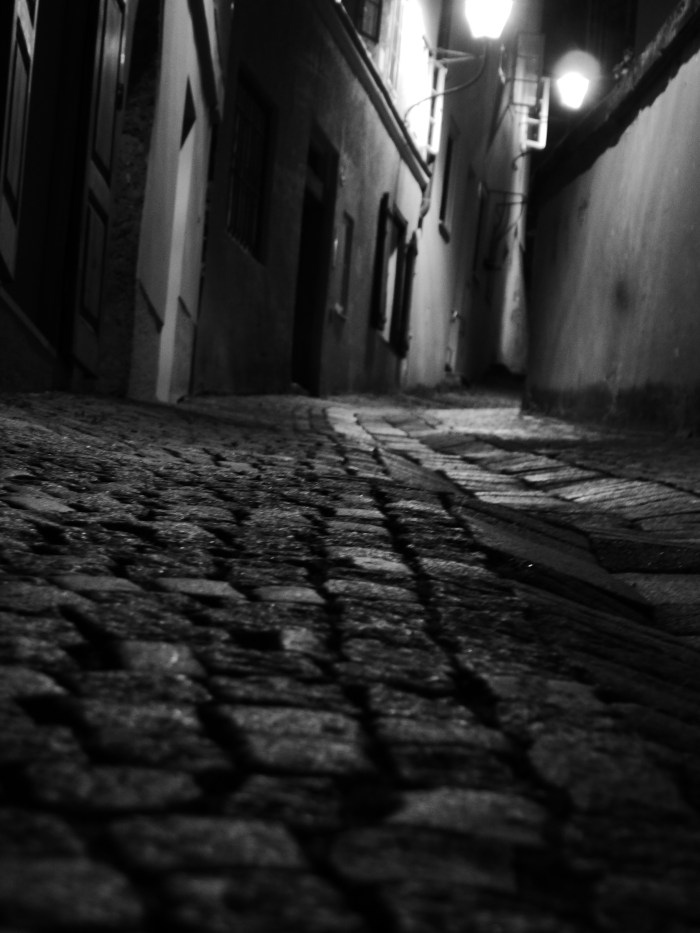
On ‘Seeing and Noticing’: William S. Burroughs, The Beat Hotel and ‘Taking The Colour Walk’ Through The Streets of Paris

By Marcus D. Niski

In a dilapidated hotel famously dubbed The Beat Hotel by its colourfully eccentric inhabitants, a coalescence of some of the Beat generation’s most important protagonists came together under one roof to push forward the frontiers of literature, painting and psychic awareness.

In an extraordinary outburst of creative energy, Gregory Corso wrote some of his most important poetry there, Brion Gysin and Ian Sommerville devised The Dreamachine , Allen Ginsberg worked on Kaddish (dwelling in Room 25), Burroughs and Gysin experimented with the ‘cut-ups’ and Sinclair Beiles – amongst many others who came and went –  co-authored Minutes to Go with Burroughs and Gysin amidst a burlesque carnival of creative chaos.

Always seeking new paths of creative inspiration, Burroughs also devised a fascinating observational technique known as ‘taking the colour walk’:

“I was taking a colour walk around Paris the other day … I was walking down the boulevard when I suddenly felt this cool wind on a warm day, and when I looked out I was seeing all the blues in the street in front of me… blue on a foulard…a girls’ blue sweater…blue neon…the blue sky …all the blues. When I looked again, I saw nothing but all the reds…of traffic lights…car lights…a café sign…a man’s nose…”

Excerpt from The Beat Hotel, Barry Miles, Atlantic Books, London, 2000, p 157.

Located at 9, rue Git-le-Coeur and curated under Madame Rachou’s ever watchful eye (circa 1957-1963), The Beat Hotel was undoubtedly one of the great oasis’ of Parisian creativity at that time. Indeed, in this extraordinary interview below, Sinclair Beiles recalls some of the legendary ‘eccentricities’, excesses and antics that took place amidst the dilapidated digs of  The Beat Hotel –

More biographical information about Sinclair Beiles – one of the Beat generation’s most neglected, if not tragically overlooked protagonists – can also be found at:

http://www.emptymirrorbooks.com/beat/sinclair-beiles-a-man-apart/


 – Marcus D. Niski, September 2017


Virginia Woolf: A ‘Street Haunting’

Have you ever walked along a street and imagined the lives of the strangers that you pass?

In Virginia Woolf’s 1927 essay ‘Street Haunting’, the narrator explores this imaginative act of dipping in and out of people’s minds as they move through the city’s wintry, twilight streets. From prime ministers to the homeless, the narrator examines the city’s inhabitants and the spaces they occupy. ‘What greater delight and wonder can there be than to leave the straight lines of personality’, the narrator asks, to feel ‘that one is not tethered to a single mind, but can put on briefly for a few minutes the bodies and minds of others’.

Source: The British Library, 20th Century Literature Collection Items as found at: http://www.bl.uk/collection-items/street-haunting-an-essay-by-virginia-woolf

In the meantime we agreed to forget our cares for the night. We took a little money from our savings and walked to Forty-second Street. We stopped at a photo booth in Playland to take our pictures, a strip shot of four shots for a quarter. We go a hot dog and papaya drink at Benedict’s, then merged with the action. Boys on shore leave, prostitutes, runaways, abused tourists, and assorted victims of alien abduction. It was an urban boardwalk with Kino parlors, souvenir stands, Cuban diners, strip clubs, and late-night pawnshops. For fifty cents, one could slip inside a theatre draped in stained velvet and watch foreign films paired with soft porn.

– ‘Patti Smith’s “Forty Second Street Urban Boardwalk” in: Patti Smith,  Just Kids, Bloomsbury, London, 2010, P 107.


Place/Space/Writing

How do we live in our cities? How do we meaningfully interact with them in a world ever-increasingly devoted to time-functional tasks and the economic engine that has become the driving force behind all of the world’s great cities?

Our challenge is to slow down, to see and notice our cities and engage with them at the microcosmic level to enjoy the myriad small things that go to make up the joys of urban environment as well as our own habitation within it.

My interest in these questions was profoundly inspired the work  of George Perec, most particularly, his brilliant collection of meditations on place and space ­ Species of Spaces and Other Pieces which take us from the street, to the apartment and even to the writing desk in an examination of how we interact with our spaces both public and private.

Perec was a master of what I call ‘writing the mundane’: through taking time to dig deeply into the everyday, to see and notice the world around us with acute attention to detail, Perec becomes a master of taking such seemingly mundane interactions – the objects on my work-table, what I can observe in a public square or street, what I can say about the private spaces that I live in – and turning them into some of the most insightful and imaginative literary depictions of the arts of everyday life.

From the village to the mega-city we live in a kaleidoscope of cultures that are as infinitely diverse as the stories of that diversity which emerge from the streets, lanes, gutters and built environments envelope them.

Naked Cities Journal is about sharing these stories of the minutiae of everyday life from different cultures and different storytellers from around the globe.

Marcus D. Niski,  June 2017