In search of the bohemian….

Reflecting philosophically, I have often attempted to examine the notion of bohemianism, to pin it down to some sort of tangible set of ideals and identities: all attempts have thus failed save to say that bohemianism is more a state of mind than anything else…
A friend of mine some time ago told me an anecdote about a group of Italian anarchists who turned up at a protest rally dressed in fine business suits. This clash of images provoked a completely perplexed response from the authorities who could not reconcile their dress code with the contradiction in their actual intentions.
Thus, bohemianism, like anarchism, should best be reserved as a ‘technique of mind’ rather than a code of dress that often presents mere images in place of deeply held sets of ideas or ideals.

[MN] 7 December 2021

Blaise Cendrars: ‘On Grammar’

I ignore and despise grammar, which is at the point of death, but I am a great reader of dictionaries and if my spelling is none too sure it’s because I am too attentive to the pronunciation, this idiosyncrasy of the living language. In the beginning was not the word, but the phrase, a modulation. Listen to the songs of birds!

– Blaise Cendars in Paris Review Interview, The Art of Fiction, no. 38.

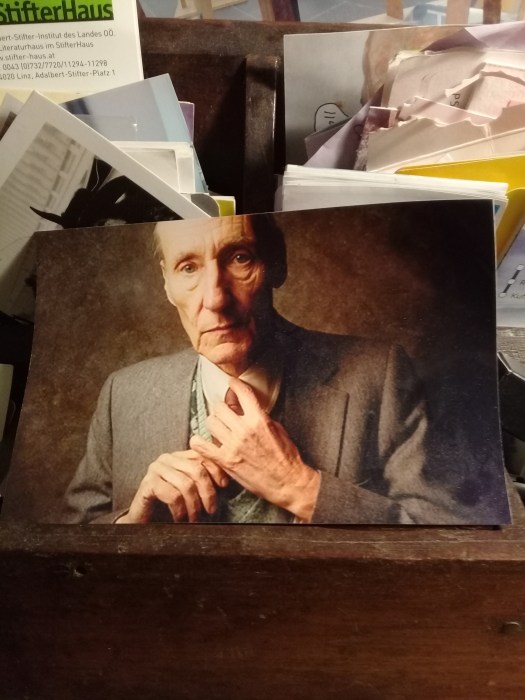
William S. Burroughs: ‘On Travel in Time and Space’

“ I think the political and social chaos we are seeing on every side reflects an underlying biologic crisis – the end of the human line. All species are doomed from conception like all individuals. Evolution did not come to a reverend halt with Homo Sapiens. We have the technologies to re-create a broad artifact and to produce improved and variegated models designed for space conditions…”

– William S. Burroughs

Julia Kristeva — The Vale of Soul-Making

When the starry sky, a vista of open seas, or a stained-glass window shedding purple beams fascinate me, there is a cluster of meaning, of colors, of words, of caresses, there are light touches, scents, sighs, cadences that arise, shroud me, carry me away, and sweep me beyond the things I see, hear, or think. The “sublime” object dissolves in the raptures of a bottomless memory. It is such a memory, which, from stopping point to stopping point, remembrance to remembrance, love to love, transfers that object to the refulgent point of the dazzlement in which I stray in order to be.

— Julia Kristeva, Powers of Horror: An Essay on Abjection. (Columbia University Press; Reprint edition April 15, 1982)

Julia Kristeva — The Vale of Soul-Making

The Archaeology of Foucault update 12: archival work in Paris on drafts of The Archaeology of Knowledge and Foucault’s notebooks — Foucault News

Originally posted on Progressive Geographies: As the last update on this book said, I was able to make a trip to Paris over reading week. I spent most of the time at the BNF working on archival materials related to The Archaeology of Knowledge. There is a manuscript on philosophical discourse, probably written in 1966, which seems to be an…

The Archaeology of Foucault update 12: archival work in Paris on drafts of The Archaeology of Knowledge and Foucault’s notebooks — Foucault News

On Boredom

When hit by boredom, go for it. Let Yourself be crushed by it; submerge, hit bottom. In general, with things unpleasant, the rule is the sooner you hit bottom, the faster you surface. The idea here, to paraphrase another great poet of the English language, is to exact full look at the worst. The reason boredom deserves scrutiny is that it represents pure undiluted time in all its repetitive, redundant, monotonous splendor.

– Joseph Brodsky in On Grief and Reason.

“You’ve nothing else to give the world which no one else can give except yourself” – Quentin Crisp