 © Matt Weber
via BOND Times Sq.1985 — Black and White Street Photographs of New York City by Matt Weber
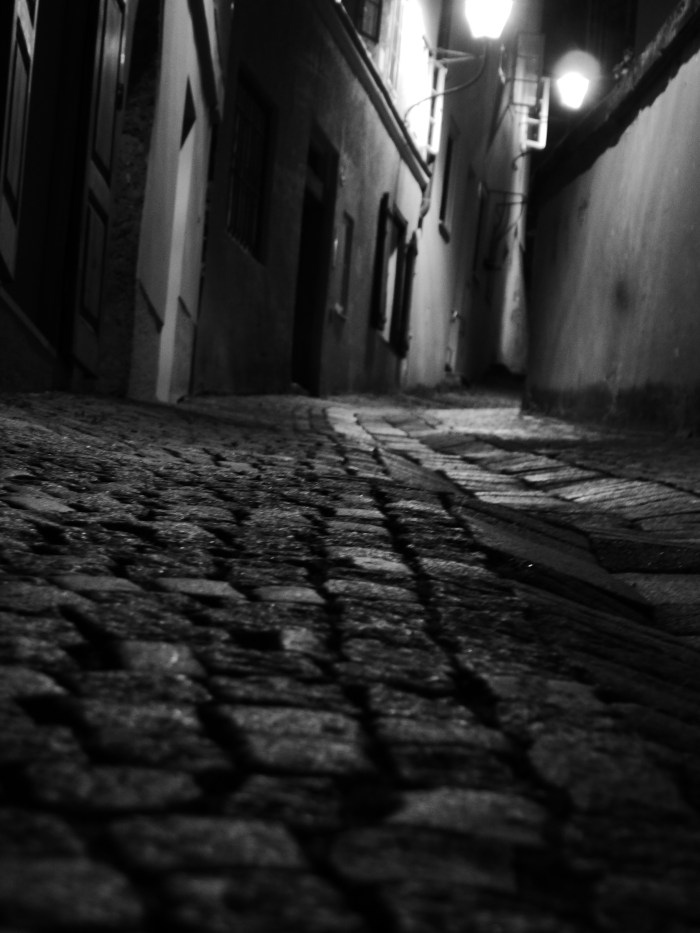
A collection of writings about place space writing and art …
Sometimes intriguing. Sometimes ornate. Sometimes narrow. Sometimes wide. Sometimes majestic. Sometimes mundane. Always functional.
This image was taken by me at the legendary Chelsea Hotel in New York, 2010.
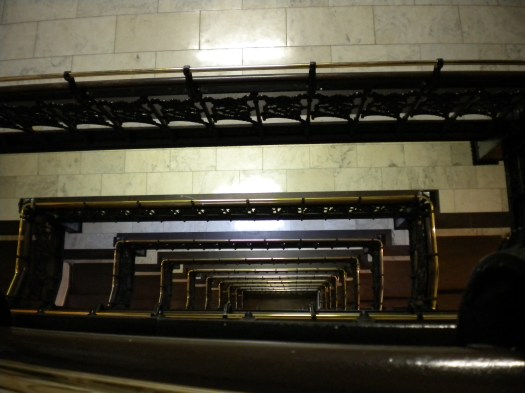
Image © Marcus D. Niski 2010-2017
 © Matt Weber
Superbly evocative New York street photography by Matt Weber via “Mona Lisa” SOHO 1985 — Black and White Street Photographs of New York City by Matt Weber

Pedestrians traveling 41st Street in Manhattan between Fifth Avenue and Park Avenue may notice special street signs if they pay close attention – that two-block stretch is known as Library Way. Embedded within the sidewalk at regular intervals you will find 96 unique bronze plaques. The plaques were designed by sculptor Gregg LeFevre, and each […]
The fabulous Library Way walking trail I fondly remember following along during a cold New York winter in 2010 as found at: A Walk Along Library Way — Finding NYC
By Marcus D. Niski
Herbert Edwin Huncke undoubtedly ranks amongst one of the most fascinating yet underestimated figures of the ‘Beat’ world.
Street urchin, raconteur, hustler, and chronicler of New York’s street life, Huncke was a unique figure in New York’s literary scene whose presence was reluctantly – but ultimately – acknowledged as a testament to the power and simplicity of his storytelling. Huncke’s notebooks also serve as a testimony to his attempts to document his many encounters at street level and are indeed fascinating original chronicles that capture elements of his often turbulent but always colourful life.
Born into a middle class family in Greenfield, Massachusetts, Huncke’s colorful life was shaped early on. A restless child and “chronic runaway,” Huncke hit New York City permanently in 1939 at the age of 24, immediately gravitating to Forty-Second Street where he began hustling for sex.
Widely immortalized in the literature of his confrères — William Burroughs, Jack Kerouac, Allen Ginsberg, and John Clellon Holmes — Huncke served as a model for literary characters such as Elmo Hassel in Kerouac’s On The Road and Herman in Burroughs’ Junky (amongst many other literary characterizations).
As a “Virgilian guide” to New York’s underworld, Huncke would skilfully guide Burroughs into the subterranean world of narcotics, as well as provide a great degree of source material for his literary adventures. Yet Huncke’s own creative endeavors have often taken a back seat to those of his contemporaries.
Throughout his long and often tumultuous life, Huncke wrote his observations, reflections, and vignettes in a series of notebooks [1]. This stock of tales undoubtedly underpinned the Huncke mythology. As long time friend and confidant Raymond Foye recollects:
There remains an indelible image of Herbert Huncke the writer, frozen forever in time: homeless and alone, couched in a Times Square pay toilet with notebook on knees, furtively composing his latest tale from the underground.
– Raymond Foye in The Herbert Huncke Reader, William Morrow & Co, New York.
Huncke’s notebooks also form an evocative record of his trials and tribulations as a sage and survivor on New York’s often brutal and unforgiving streets. Huncke’s notebook revelations also provide an insight into “a way of life, a vocabulary, references, a whole symbol system” (as Burroughs put it in Junky) that has now largely disappeared. The world of “crash pads, speakeasies, [and] all-night jam sessions with Charlie Parker or Dexter Gordon” were part of the “carnie” world that informed Huncke’s reflections on an often chaotic, always kaleidoscopic culture. Indeed, the frustrations of Huncke’s itinerant existence are eloquently expressed in this entry in his notebooks:
lost to the streets — lost completely to a life I once knew — stealing — junk– all night wandering– thru the streets — lost completely to a life I once knew – — stealing — junk all night wandering thru the city — no pads– no friends — no way of life – almost convinced prison is a solution — shriveling within at the mere thought — wishing for death — willing death… [Untitled MS Page, Notebook and Diary excerpts, 1959-1960] [2]
A master storyteller, raconteur and polished performer, Huncke would often use his considerable verbal skills to cadge money, drinks and other necessities from his often wary and weary friends. In this vivid passage from Frank McCourt’s Teacher Man, McCourt describes a typical encounter with Huncke on one of his visiting rounds cadging whatever spare change he could towards his version of what he saw as ‘the necessities of life’:
I stepped into the hallway for one of our brief occasional conferences where he explained he happened to be in this neighborhood and he was thinking about me and wondered how is was doing. Also, he happened to be caught short for necessities and wondered if I might have any spare change about me. He appreciated past kindnesses and even though he saw little possibility of repayment he would always remember me warmly. It was such a pleasure to visit me here and to see the youth of America, these beautiful children, in such capable and generous hands. He said thanks and he might see me soon at Montero’s Bar in Brooklyn, a few blocks from his apartment. In a few minutes the ten dollars I slipped him would be passed to a Stuyvesant Square drug dealer.
That’s Huncke, I told them. Pick up any history of recent American writing or the Beat Generation and in the index you’ll find Huncke, Herbert.
Alcohol is not his habit but he’ll kindly allow you to buy him a drink at Montero’s. His voice is deep, gentle and musical. He never forgets his manners and you’d rarely think of him as Huncke the Junkie. He respects law and obeys none of it.
He’s done jail time for pickpocketing, robbery, possession of drugs, selling drugs. He’s a hustler, a con man, a male prostitute, a charmer, a writer. He is given credit for coining the term Beat Generation. He uses people until he exhausts their patience and money and they tell him, Enough Huncke. Out, out already. He understands and never carries grudges. It’s all the same to him. I know he’s using me, but he knew everyone in the Beat movement and I listen to him talk about Burroughs, Corso, Kerouac, Allen Ginsberg. R’lene Dahlberg told me that Ginsberg once compared Huncke to St. Francis of Assisi. Yes, he’s a criminal, an outlaw, but he steals only to sustain his drug habit and makes no profit out of his activities.
– Frank Mc Court’s portrait of Herbert Huncke in Teacher Man, Scribner, New York, 2005 (p 250-251).
Huncke’s literary legacy lives on in a number of works that were published in his lifetime [3] as well as a definitive collection of writings – The Herbert Huncke Reader – collected together by Benjamin G. Schafer with an Introduction by Raymond Foye as well as a superb Biographical Sketch of Huncke written by Huncke’s Literary Executor Jerome Poynton. [4]
William S. Burroughs acknowledged the “extraordinary” nature of Huncke’s experiences that were “quite genuine” in his Forward to The Herbert Huncke Reader in the following brief remarks –
In ‘The Thief’s Journal’, Genet says there are very few people who have earned the right to think. Huncke had adventures and misadventures that were not available to middle-class, comparatively wealthy college people like Kerouac and me: “Some write home to the old folks for coin. That’s their ace in the hole.” Huncke had extraordinary experiences that were quite genuine. He isn’t a type you find anymore.
– William S. Burroughs in The Herbert Huncke Reader, William Morrow & Co, New York.
Huncke was undoubtedly a unique character in the history of Times Square lore [5]: a “genuine” character of the streets who wielded far more influence over the imaginations of the founding fathers of the American Beat movement than he is often given credit for.
Marcus D. Niski, August 2017
[1] In 2010, I had the privilege of visiting the Columbia University’s Butler Library in New York to view their deposit of Huncke’s papers and notebooks. My analysis of Huncke’s notebooks, as well as selected images of them can found in my realitystudio.org article – ‘The Writer’s Notebooks of Herbert Huncke’ by Marcus D. Niski at: ‘http://realitystudio.org/criticism/the-writers-notebooks-of-herbert-huncke/
[2] Ibid.
[3] Huncke’s Writings: A Select Bibliography
Guilty of Everything: The Autobiography of Herbert Huncke (New York: Paragon House Publishers, 1990), Edited by Don Kennison, foreword by William S. Burroughs. ISBN 1-55778-044-7
The Evening Sun Turned Crimson (Cherry Valley, NY: Cherry Valley Editions, 1980), ISBN 0-916156-43-5.
Huncke’s Journal (Poets Press, 1965). Edited by Diane Di Prima. Foreword by Allen Ginsberg.
The Herbert Huncke Reader Edited by Benjamin Schafer (New York: Morrow, 1997), ISBN 0-688-15266-X
Again–The Hospital (White Fields Press, Louisville, 1995). 1/50 copies. (Broadside; single sheet, measuring 12 by 22 inches, illustrated with a photograph of Huncke.)
Herbert E. Huncke 1915-1996 (New York: Jerry Poynton 1996). (Limited edition of 100 copies of the program for the Herbert Huncke memorial at Friends Meetinghouse, New York City. Includes original texts.)
From Dream to Dream (Dig It! 567912-2, Music & Words, Netherlands, 1994, CD)
Herbert Huncke – Guilty of Everything. Double-CD of Huncke’s 1987 live reading at Ins & Outs Press, Amsterdam, the Netherlands. Co-production released by Unrequited Records, San Francisco (2012).
[4] The full text of Jerome V. Poynton’s biographical sketch of Hunkce can be found at http://huncketeacompany.com/about/ which celebrates Huncke’s life and Centennial Year (1915–2015).
[5] Huncke’s Obituary in The New York Times by Robert McG. Thomas Jr. (Aug. 9, 1996) can be found at: http://www.nytimes.com/1996/08/09/arts/herbert-huncke-the-hipster-who-defined-beat-dies-at-81.html
Huncke’s Dirty Seedy New York
In the meantime we agreed to forget our cares for the night. We took a little money from our savings and walked to Forty-second Street. We stopped at a photo booth in Playland to take our pictures, a strip shot of four shots for a quarter. We go a hot dog and papaya drink at Benedict’s, then merged with the action. Boys on shore leave, prostitutes, runaways, abused tourists, and assorted victims of alien abduction. It was an urban boardwalk with Kino parlors, souvenir stands, Cuban diners, strip clubs, and late-night pawnshops. For fifty cents, one could slip inside a theatre draped in stained velvet and watch foreign films paired with soft porn.
– ‘Patti Smith’s “Forty Second Street Urban Boardwalk” in: Patti Smith, Just Kids, Bloomsbury, London, 2010, P 107.
By Marcus D. Niski
The Automat has an unlikely place in the pantheon of American Literary History. At once a place of simplicity, convenience and stark utilitarian dining, the Automat chains of New York City – dominated by Horn & Hardart and Bickfords – became the meeting places of some of America’s most famous and infamous literary figures. As legend would have it, a cavalcade of some of America’s most important writers, artists and playwrights would grace the shores of the humble Automats most notably Bickfords located on West 42 Street where Beat luminary Herbert Huncke was said to be almost an permanent fixture. [1]
From William S. Burroughs and Jack Kerouac, to Woody Allen, Neil Simon, Patti Smith – amongst countless legions of other lesser well-known writers, artists and intellectuals – many notable New York City writers are said to have imbibed in, and in many instances, immortalized the humble Automat in their novels, short stories, plays, and films. Indeed, the Automat seemed like a writer’s domiciliary dream come true: what was there not to like about Automats given the perfect combination of enticements for any malnourished, impecunious writer or artist – cheap food (relatively), 24 hour convenience, winter warmth, and the company of like-minded eccentric souls. Accordingly, playwright Neil Simon is said to have proudly declared: “The Automat! The Maxim’s of the disenfranchised”.
The most potent “secret weapon” of the Automat was undoubtedly, as Bill Demain writes, the freshly brewed coffee [!] :
For all the good food, the Automat’s real secret weapon was its coffee. Horn & Hardart popularized fresh drip-brewed coffee in New York. Prior to the Automat, coffee was often harsh and bitter, boiled and clarified with eggshells. The Automat’s smooth aromatic brew flowed regally from ornate brass spigots in the shape of dolphin heads. In their heyday, Automats sold over 90 million cups of their fresh-brewed coffee each year. And they were committed to keeping it fresh. When an Automat employee brewed coffee, they filled out a time card. After twenty minutes, they discarded whatever coffee was left and made a fresh pot. If there was any doubt about Horn & Hardart’s commitment to java, the Automat even adopted Irving Berlin’s “Let’s Have Another Cup Of Coffee” as their unofficial theme song.
– Automatic for the People: Remembering the Automat Restaurants, by Bill Demain, in Mental Floss, April 21 2015.
The demise of the Automats as a night-time creative and culinary haven was said (amongst a range of complex factors) to have coincided with a dramatic loss of night-time patronage due to the perceived lack of safety at night during the period of the 70s and 80s when New York experienced a wave of muggings and rising levels of street crime leading many residents to shy away from the tradition of frequenting the many Automats dotted around Manhattan at night.
While the Automat may have physically disappeared from the presence of Manhattan’s unique urban landscape, it remains forever immortalized in literature and American art most notably in Edward Hopper’s beloved painting Automat (1927) which “portrays a lone woman staring into a cup of coffee in an Automat at night.”
Patti Smith similarly immortalizes her reminiscences of the Automat which she often frequented with her partner and muse Robert Mapplethorpe in this passage from Just Kids describing her encounter with Allen Ginsberg who provides her with some spare change for a cheese-and lettuce sandwich –
Horn and Hardart, the queen of Automats, was just past the tackle shop. The routine was to get a seat and a tray, then go to the back wall where there were rows of little windows. You would slip some coins into the slot, open the glass hatch, and extract a sandwich or fresh apple pie. A real Tex Avery eatery. My favorite was chicken potpie or cheese and mustard with lettuce on a poppy seed roll. Robert liked their two specialties, baked macaroni and cheese and chocolate milk, but for a girl raised on Bosco and powdered milk, it was always too thick, so I just got a coffee.
I was always hungry. I metabolized food quickly. Robert could go without eating for much longer than me. If we were out of money we just didn’t eat. Robert might be able to function, even if he got a little shaky, but I would feel like I was going to pass out. One drizzly afternoon I had a hankering for one of those cheese-and-lettuce sandwiches. I went through our belongings and found exactly fifty cents. slipped on my gray trench coat and Mayakovsky cap, and headed to the Automat.
I got my tray and slipped in my coins but the window wouldn’t open. I tried again without luck and then I noticed the price had gone up to sixty-fve cents. I was disappointed, to say the least, when I heard a voice say, “Can I help?’
I turned around and it was Allen Ginsberg…
He told me he was writing a long elegy for Jack Kerouac who had just recently passed away. “Three days after Rimbaud’s birthday,” I said. I shook his hand and we parted company.
– From: Patti Smith in Just Kids, Bloomsbury, London, 2010.
William S. Burroughs described the generalized impact of gentrification in his elegant observation that ‘all the angels are leaving all of the alcoves’ conveying a sense of damage, loss and change in the face of relentless ‘progress’ often at the cost of simplicity and tradition. The Automat, as does so many other urban phenomenon of previous ages and epochs, seems relegated to a bygone era now fortuitously frozen in time in some of America’s great art and literature: a legacy we can be most sincerely grateful for.
Marcus D. Niski, July 2017
[1] Huncke was a legendary story teller and it doesn’t take too much imagination to conjure him up engaging in one of his famous all-night “bullshit sessions” [as Huncke himself would refer to similar sessions at the Chelsea Hotel as documented in Francois Bernadi’s superb short film Original Beats] at Bickfords surrounded by various acolytes, misfits and colorful characters of the night.
For a further biographical portrait of Huncke and images of his writers notebooks see my: ‘The Writer’s Notebooks of Herbert Huncke’ by Marcus D. Niski, Reality Studio, 26 March 2012 as found at: http://realitystudio.org/criticism/the-writers-notebooks-of-herbert-huncke/
At The Automat – A scene set in an Automat from the film Sadie McKee (1934) starring Joan Crawford
 Naked Cities Journal
You must be logged in to post a comment.