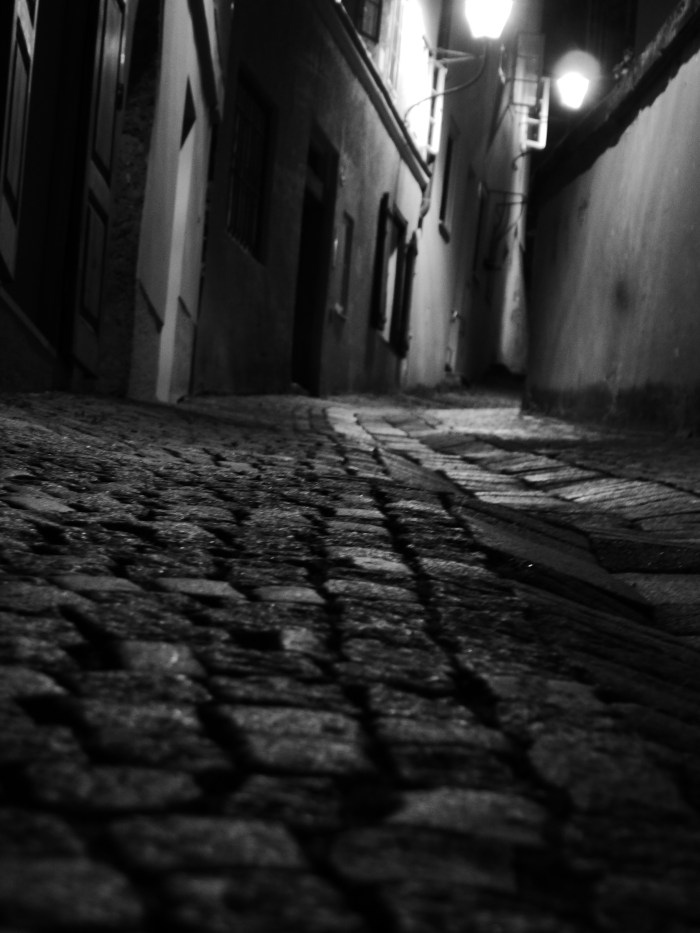
The Camera Eye: I – by Marcus D. Niski

Imagine that you are now a Human Camera …

The Camera Eye

John Dos Passos’ [U.S.A]

John Dos Passos was justifiably lauded as one of the twentieth century’s great American writers. His U.S.A trilogy, in which the stream of consciousness technique known as The Camera Eye can be found, is actually a compendium of three separate novels – The 42nd Parallel, 1919, and The Big Money — which form a ”collective portrait of America, shot through with sardonic comedy and brilliant social observation.”

Throughout the novel, as the Library of America editorial for the U.S.A trilogy suggests, Dos Passos employs –

A startling range of experimental devices [that] captures the textures and background noises of 20th-century life: “Newsreels” with blaring headlines; autobiographical “Camera Eye” sections with poetic stream-of-consciousness; “biographies” evoking emblematic historical figures like J.P. Morgan, Henry Ford, John Reed, Frank Lloyd Wright, Thorstein Veblen, and the Unknown Soldier. Holding everything together is sheer storytelling power, tracing dozens of characters from the Spanish-American War to the onset of the Depression.

The Camera Eye, to me, represents a metaphor for exactly what it implies: the notion that the human eye can be used as a ‘recording camera’ in connection with reportage that is written down, either in the form of a stream of consciousness, or as a focused tool for delivering acute narrative descriptions of the world around us.

Often I have taken my students into the streets and laneways and asked them – poised at a fixed position – to SPONTANEOUSLY write down what they see in front of them and without THINKING about it too much, to try to RECORD as accurately as they can what they SEE, as well as to SLOW DOWN their mind as an enabling tool in the process.

Next time you have your notebook in hand try this simple exercise: you might be very surprised what springs from it. Indeed, the continued honing of your skills using this observational technique can sometimes lead to some remarkable results.

Marcus D. Niski,  June 2017

Walter Benjamin’s One Way Street : The Writer’s Technique in Thirteen Thesis

By Marcus D. Niski

“Think about Benjamin, the writer or the thinker, and he has almost always been there first, and written ahead of you…”

– Brian Hanrahan, From ‘For Future Friends of Walter Benjamin’, Los Angeles Review, July 26, 2012.

Walter Benjamin’s classic manifesto One Way Street: The Writer’s Technique in Thirteen Thesis is a pure crystalline gem that summarizes Benjamin’s approach to his writing craft in a highly original, quirky, and novel way which explains some of the classic hallmarks of Benjamin’s writing be it in his descriptive, theoretical or philosophical musings on a truly kaleidoscopic range of subjects, or his film criticism, travel memoir or critical theory essays.

Benjamin revelled in the minutiae of everyday life as Susan Sontag writes in her Introduction to One Way Street –

Much of the originality of Benjamin’s arguments owes to his microscopic gaze (as his friend and disciple Theodore Adorno called it), combined with his indefatigable command over theoretical perspectives. “It was the small things that attracted him most”, writes Scholem. He loved old toys, postage stamps, picture postcards, and such playful miniaturizations of winter inside a glass globe that snows when it is shaken…

Best known for his massive unfinished opus The Arcades Project (Das Passagen-Werk), Benjamin emerged from almost complete obscurity – save those few who were familiar with his intellectual and philosophical writings – to become a true literary comet that illuminated all of those subjects which he touched upon.

Benjamin is undoubtedly one of my favourite literary writers and One Way Street undoubtedly one of my favourite ‘self-observational’ Benjamin pieces.

Walter Benjamin, One-Way Street

Post No Bills

The Writer’s Technique in Thirteen Theses

I. Anyone intending to embark on a major work should be lenient with himself and, having completed a stint, deny himself nothing that will not prejudice the next.

II. Talk about what you have written, by all means, but do not read from it while the work is in progress. Every gratification procured in this way will slacken your tempo. If this regime is followed, the growing desire to communicate will become in the end a motor for completion.

III. In your working conditions avoid everyday mediocrity. Semi-relaxation, to a background of insipid sounds, is degrading. On the other hand, accompaniment by an etude or a cacophony of voices can become as significant for work as the perceptible silence of the night. If the latter sharpens the inner ear, the former acts as a touchstone for a diction ample enough to bury even the most wayward sounds.

IV. Avoid haphazard writing materials. A pedantic adherence to certain papers, pens, inks is beneficial. No luxury, but an abundance of these utensils is indispensable.

V. Let no thought pass incognito, and keep your notebook as strictly as the authorities keep their register of aliens.

VI. Keep your pen aloof from inspiration, which it will then attract with magnetic power. The more circumspectly you delay writing down an idea, the more maturely developed it will be on surrendering itself. Speech conquers thought, but writing commands it.

VII. Never stop writing because you have run out of ideas. Literary honour requires that one break off only at an appointed moment (a mealtime, a meeting) or at the end of the work.

VIII. Fill the lacunae of inspiration by tidily copying out what is already written. Intuition will awaken in the process.

IX. Nulla dies sine linea – but there may well be weeks.

X. Consider no work perfect over which you have not once sat from evening to broad daylight.

XI. Do not write the conclusion of a work in your familiar study. You would not find the necessary courage there.

XII. Stages of composition: idea – style – writing. The value of the fair copy is that in producing it you confine attention to calligraphy. The idea kills inspiration, style fetters the idea, writing pays off style.

XIII. The work is the death mask of its conception.

From, One Way Street and Other Writings, Surkampf Verlag, Frankfurt.

Marcus D. Niski,  May 2017


How to Analyse a City: Part I…

By Marcus D. Niski

How to Analyse a City: Observation, Memory, Reflection and the Journal/Notebook as a Tool for Observing and Analysing Cities in Action

One of the most useful ways to engage with a city is to learn how to read it through the process of observation, memory and reflection.

To take time to be in the city, enjoy the city and to practice the ancient art of being a FLANEUR in the city.

The Flaneur: or, How to Read a City

 ‘…as Walter Benjamin explains, the flaneur is in search of experience, not knowledge…’

– Edmund White in The Flaneur: A Stroll Through the Paradoxes of Paris, Bloomsbury, London, 2008.

 Who, or What, is a Flaneur…?

The flâneur, or the notion of the flaneur, is a creation of the 19th century Parisian streets that offered an almost unlimited kaleidoscopic opportunity for social observation and experience.

The flaneur, by definition, is an ‘exemplary stroller’ who strolls through the streets at a pace in which observation becomes the centre point of his experience.

As Edmund White suggests in his stunningly observant account of the flaneur and the ‘paradoxes of Paris’, Walter Benjamin was probably one of the most acute observers of the idea of the flaneur and one of literature’s most important writers in documenting the activities of this unique Parisian creature.

The flaneur is not a tourist, shopper or pedestrian eager to rapidly consume the landscape, but one who is almost overwhelmed by the delectable possibilities of the urban landscape; so much so that he is not really sure where to start or where his journey will take him.

The Journal and the Notebook and How to Observe a City

One of the best ways to really learn to observe a city is to carry a notebook or a journal with you in your pocket or in your bag and to record the observations that you see and hear all around you.

This is one of the simplest and most powerful techniques that a writer can use in gathering material for their writing.

Some Observational Techniques for the Journey: Memory, Observation, Reflection – Writing or Slowing Down and Observing – The City as Art and Text

Next time as you wander through the streets and lanes in your city, you might like to consider the following creative ideas as the basis for making notes in your notebook which can later be used as the basis for reflection and writing in a wide range of genres:

Poemwrite a poem based on an observation you make…

Found poemconstruct and write down your found poem in your notebook…

Observationalrecord an observation/s you have made…

Overheard conversation – record and overheard conversation as dialogue…

Visual image  – record a visual image that you have seen as the basis for poem or starting point for a piece of writing…

Remembrance  – Record a remembrance that may have been triggered by something you have seen…

Smell – use your sense of smell and record some notes or reflections…

Reflection – use a visual image to reflect or to write a mediation about what you have just seen …

Colour – Taking the Colour Walk: William S. Burroughs and the ‘colour walk’ through Paris …

“I was taking a colour walk around Paris the other day … I was walking down the boulevard when I suddenly felt this cool wind on a warm day, and when I looked out I was seeing all the blues in the street in front of me… blue on a foulard…a girls’ blue sweater…blue neon…. the blue sky …all the blues. When I looked again, I saw nothing but all the reds…of traffic lights…car lights…a café sign…a man’s nose…”

Excerpt from The Beat Hotel, Barry Miles, Atlantic Books, London, 2000, p 157.

In the next two Journal entries, I’ll talk about one of my favorite creative and observational writing techniques which I call the The Camera Eye, as well as my two most favorite writers – Blaise Cendrars and John Dos Passos – who both used this technique as an important exploratory and experimental tool amongst their broad armory of creative writing techniques.

Marcus D. Niski,  June 2017

[1] Modernist Cultures 7.2 (2012)  180-204

Choosing and Using Your Writer’s Notebook

By Marcus D. Niski

Choosing Your Writer’s Notebook

The notebook is a crucial writing tool for recording observations of place, space, research notes, all of which are fundamental to the ascetic and practical activities of any writer.

Choosing your notebook is a very individual thing and there are no real guidelines for this other than choosing one that looks and feel right for you as an individual.

Believe it or not, I feel that this is a crucial part of the process in as much as that if your notebook does not feel right for you, then there is a good chance that it will sit on the shelf and not fulfill the special role that it is intended to fill.

Some hints and ideas that will help you choose a notebook that is right for you include attention paid to the following:

Paper:

Try wherever possible to select a notebook that is made of acid free paper, as this paper will inevitably last much longer due to its proper archival quality.

Non-Acid free paper will tend to yellow and break down over the years, hence it is worth spending a little extra to get good long lasting paper on which to write.

Binding:

Always choose a notebook that is solidly bound, as one which is poorly bound will quickly fall apart when the binding breaks down. The best forms of binding are those that use the traditional sewn paper interleaving and are then glued and finished along traditional classical binding lines.

Physical Feel + Touch:

Crucial: your notebook must have a feel that is right for you otherwise you won’t use it. Feel and touch are vital ingredients to a notebook that you will use

Size:

Size is important, as you must think about the maximum size that is satisfactory for you to carry around with you. Notebooks that are too heavy, bulky or awkward will not work well for you.

Price:

Don’t spend too little or too much. Remember that once you select a type of notebook that you want to use bear in mind the repeat cost each time you buy one once your old notebook one has been filled up.

Availability:

Choose a notebook that you will be able to secure a regular supply of once you have settled on a particular type.

Ornateness:

Overly ornate notebooks will often cause you to hesitate in using them.

The notebook is to the writer what the camera is to the photographer: an essential tool of observation and recording – so never forget to keep your notebook you at all times – inspiration often strikes randomly and its vital to capture your thoughts freshly and immediately which is the great value of the notebook.

Keeping writer’s notebooks has been one of my greatest enduring pleasures. At times an almost addictive pleasure, but one which is endlessly satisfying.

Marcus D. Niski,  14 May 2017

Quotations from My Writer’s Notebooks

By Marcus D. Niski

Over a long period of time now, I’ve collected a huge range of quotations and aphorisms from my reading and research that I’ve written down by hand in my notebooks, as well as engaging in the almost daily practice of writing my own observations and aphorisms – I suspect Paul Valery would be proud of my efforts indeed!

While I’ve made a sustained personal effort, Valery was undoubtedly one of the most prolific notebook writers of all time.

For those readers who are unfamiliar with his work, Valery was a master of observation and notetaking as the 29 published volumes of his Cahiers (notebooks) attest to:

 “Every morning he would get up at around five o’clock and write meditations, notes, and speculations in small volumes that he intended for no one but himself. There were more than 250 of these notebooks at the end of his life, and they are not only now available in published form, but are, ironically, among the most important and most read—most public—of his writings…” – Paul Valéry 1871–1945

Here are some of my favorite quotations and aphorisms on place, space, and writing from my collection of writers notebooks – particularly those around the themes of seeing, noticing and observing – the stuff of all great observational and literary writing whether about cities or otherwise …

Marcus D. Niski,  May 2017


Inside the Writer’s Notebook

By Marcus D. Niski

On Keeping a Writer’s Notebook

“The notebooks of a writer have a very special function: in them he builds up, piece by piece, the identity of a writer to himself . . .”

– Susan Sontag

“…the point of my keeping a notebook has never been, nor is it now, to have an accurate factual record of what I have been doing or thinking”

– Joan Didion in Slouching Towards Bethlehem

For many years now I have been keeping as series of writer’s notebooks that I often refer to at different times and for different purposes.

These steadily accumulating archives with their pure white acid-free pages contain a number of amusing, intriguing and sometimes mundane treasures. From lists of books and research references, to exotic insights drawn from the ancients, my notebooks provide the perfect device for accumulating so much usable material for both fiction and non-fiction writing projects alike.

In spite of their obvious lack of technological sophistication, the humble writer’s notebook provides one of the most simple and reliable devices for recording a vast range of potential literary treasures.

Quotations and other fragments from the works of Henry Miller, Jean Genet, Blaise Cendrars, Albert Camus and Antoine de Saint-Exupery as well as poems, scribbled notes, reflections, postcards and other objets d’art are but a few examples of the sorts of literary flotsam and jetsam that adorn my much treasured notebooks.

The beauty and importance of the notebook undoubtedly lays not so much in what is recorded, but in the very fact that we are attuned that there is so much that can be recorded.

Unlike the journal, notebooks are by their very nature random and spontaneous: the golden rule is that there are no firm rules about form or structure. Record what you like where and whenever you like. Notebooks are the ideal way of recording overheard conversations, observations, random thoughts and streams of consciousness – all of which may provide some inspiring and intriguing material to use either as a departure point for writing or as material in an existing writing project.

One my most favorite aspects of keeping a series of notebooks over the years has been the collecting of quotations. From Marcus Aurelius and Euripides, to Goethe and Shakespeare, my notebooks have become an important aide memoir to some of the world’s great literature. Whenever I read I am always with a notebook at hand waiting for some charming or captivating morsel to transcribe into to my collection.

Part of the challenge in keeping a writer’s notebook undoubtedly lies in utilising your powers of insight and imagination. Learning to see more acutely, read more critically and recording detail more effectively are undoubtedly important skills in any writers’ armoury. Use you notebook as a means of recording whenever and wherever possible.

My obsession with writer’s notebooks has lead me to a never-ending personal journey that has physically taken me from the literature archives in my former home city of Melbourne’s State Library, to New York Public Library’s Berg Collection and the Butler Library at Columbia University, not to mention countless hundreds hours of searching digital collections around the world.

I’ve held some of Kerouac’s most important notebooks in my very own hands in the New York Public Library’s Berg Collection, as well as perused the notebooks, scrapbooks and journals kept by William S. Burroughs at Butler Library’s archives where Herbert Huncke’s cache of notebooks are also held along with those of legendary American beat poet Gregory Corso.

Almost every day I turn to my own notebooks as a source of immense ongoing pleasure in recording thoughts, writing aphorisms, making observations and engaging in a secretive form of self-writing that has become part of an almost life-long ritual.

Your local bookshop or stationery supplier probably keeps any number of excellent notebooks. Choose one that has just the right form and feel for you and one that you will feel that you will use rather than leave on the shelf. Keep your notebook with you as often as practical and use it in particular when you are reading and/or doing research.

In the coming journal posts, I will flesh out some of the things that have intrigued me about the art and craft of choosing and using a writer’s notebook. Indeed, you would surprised like all things, that there is a kind of technique and art to choosing and using a notebook that hopefully will inspire you and instill in you a desire to keep your notebooks on a ongoing and intensive basis as an endless source of inspiration for your writing projects. I will also post some images from my notebooks that I’ve kept over the years as a source of inspiration in taking up the art form if you haven’t already!

In keeping a writer’s notebook you’ll be in the company of some of the world’s great writers. Indeed, the humble notebook has served as an important departure point for some of the most important works by such luminaries as George Orwell, Virginia Woolf, Bruce Chatwin, Bertolt Brecht, Albert Camus, Paul Auster to name but a few…

Marcus D. Niski,  April 2017

* Sections of the above writing appeared in The Australian Writer, No.313 Feb/March 1999 as reprinted in Irina Dunn’s, The Writer’s Guide, Allen & Unwin, 1999.